
The global demand for solid surface materials has increased as architects, interior designers, construction companies, and furniture manufacturers look for versatile materials that combine attractive appearances with practical performance. Solid surfaces are widely used in kitchens, bathrooms, commercial buildings, healthcare facilities, hotels, and retail environments. As international demand continues to expand, China has established itself as an important manufacturing and export destination for these products.
China’s growing position in the global solid surface market is supported by its developed manufacturing infrastructure, competitive production costs, extensive supplier networks, and increasing investment in production technology. These advantages allow manufacturers to serve customers across different industries and international markets. Businesses exploring Solid Surfaces China can access a broad selection of products, customized solutions, and manufacturing capabilities designed to meet diverse project requirements.
1. Strong Manufacturing Infrastructure
One of the main reasons China has become a major supplier of solid surface materials is its well-developed manufacturing infrastructure. The country has established industrial facilities, specialized production equipment, and extensive networks of raw material suppliers.
Manufacturing companies can manage different stages of production, including material preparation, mixing, molding, curing, cutting, polishing, and finishing. This organized production structure helps manufacturers handle different order sizes while maintaining consistent manufacturing processes.
A strong industrial foundation also makes it easier for companies to expand production capacity when international demand increases. As a result, Chinese manufacturers can serve individual project requirements as well as large-scale commercial procurement needs.
2. Competitive Production Costs
Cost efficiency is another important factor behind China’s position in the global solid surface industry. Established supply chains, large-scale production operations, and access to industrial resources can help manufacturers control manufacturing expenses.
These cost advantages may allow international buyers to explore different product categories within their purchasing budgets. Contractors, wholesalers, furniture manufacturers, and distributors can compare different materials and specifications before selecting suitable options.
However, competitive pricing should not be the only consideration when choosing a supplier. Buyers should also evaluate material composition, manufacturing consistency, durability, quality certifications, and transportation expenses.
A product with a slightly higher purchase price may provide better long-term value if it offers more reliable performance and fewer replacement requirements.
3. Extensive Product Variety
Chinese solid surface manufacturers offer a wide selection of materials, designs, colors, and finishes. This variety makes it easier for international customers to find products that complement different architectural styles and functional requirements.
Common product options include:
- Solid color surfaces: These provide clean and consistent appearances suitable for modern kitchens, bathrooms, and commercial interiors.
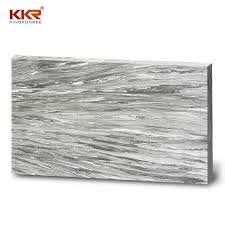
- Marble-inspired surfaces: These reproduce the visual characteristics of natural marble while offering different fabrication possibilities.
- Granite-inspired designs: These provide decorative patterns that complement traditional and contemporary interior environments.
- Translucent surfaces: Certain specialized formulations allow lighting effects to create distinctive decorative installations.
- Customized patterns: Manufacturers may develop specific colors and patterns according to customer requirements.
This broad selection helps designers and businesses coordinate surface materials with cabinetry, flooring, furniture, and other interior elements.
4. Advanced Manufacturing Technology
Continuous improvements in manufacturing technology have strengthened China’s position in the international solid surface market. Many manufacturers are investing in modern equipment and improved production methods to enhance product consistency and operational efficiency.
Automated mixing systems can help control material proportions, while advanced molding and curing equipment support more consistent production. Precision cutting and polishing technologies also improve the dimensional accuracy and surface finish of finished products.
Technology can also support customized manufacturing. Depending on their facilities, manufacturers may produce different sheet dimensions, thicknesses, colors, and fabricated components to meet project specifications.
These developments allow Chinese suppliers to compete in markets where product consistency, appearance, and technical requirements are important purchasing considerations.
5. Large Production Capacity
International construction and furniture projects frequently require substantial quantities of surface materials within specific delivery schedules. Manufacturers with adequate production capacity can support these requirements more effectively.
China’s established industrial environment enables many companies to operate production facilities capable of handling bulk orders. Larger manufacturing operations may also have more developed systems for managing inventory, production planning, and order scheduling.
For distributors and wholesalers, this capacity can be particularly valuable because they often need a dependable supply of products for ongoing customer demand.
Nevertheless, buyers should verify actual production capacity rather than relying solely on supplier claims. It is important to discuss current factory workloads, minimum order quantities, lead times, and the manufacturer’s ability to maintain consistent quality across multiple production batches.
6. Flexible Customization Services
Customization is increasingly important in modern architecture and interior design. Clients often require materials that match specific colors, dimensions, patterns, or installation requirements.
Chinese solid surface manufacturers can provide various customization services depending on their production capabilities.
These services may include:
- Custom color development
- Special sheet dimensions and thicknesses
- Different surface textures and finishes
- Customized countertops and vanity tops
- Integrated sinks and washbasins
- Special shapes and fabricated components
- Private-label and branded product solutions
Customization enables businesses to develop distinctive product collections and meet project-specific design expectations.
For large commercial projects, manufacturers may also coordinate product specifications across multiple components to maintain a consistent appearance throughout the installation.
7. Developed Raw Material Supply Chains
A reliable raw material supply chain is essential for maintaining consistent manufacturing operations. Solid surface production generally involves mineral fillers, resin systems, pigments, and other additives.
China’s developed industrial supply networks provide manufacturers with access to different raw material suppliers and supporting production resources. This can help companies manage procurement requirements and maintain production schedules.
However, raw material selection remains an important quality consideration. Differences in resin formulations, filler quality, pigment consistency, and manufacturing proportions can influence the final product’s appearance and performance.
Responsible manufacturers should maintain clear material specifications and quality checks throughout production to reduce variations between batches.
8. Strong International Export Capabilities
China has developed extensive export infrastructure that supports the international distribution of manufactured products. Solid surface suppliers can work with freight companies, shipping agents, customs brokers, and international logistics providers to serve customers in different regions.
Export experience can help manufacturers coordinate several important activities, including:
- Preparing commercial invoices and packing lists
- Arranging export documentation
- Selecting suitable packaging materials
- Coordinating container loading
- Organizing international freight
- Communicating estimated delivery schedules
Solid surface sheets and fabricated components require appropriate protective packaging because scratches, cracks, and edge damage can occur during transportation.
Experienced exporters generally understand the importance of packaging, documentation, and shipment coordination. Buyers should still confirm shipping terms, insurance responsibilities, and import requirements before placing orders.
9. Growing Demand Across Different Industries
The increasing use of solid surface materials in different industries has contributed to the growth of China’s manufacturing and export market.
Residential Construction
Solid surfaces are frequently used in residential kitchens, bathrooms, and decorative interior installations. Their smooth appearance and fabrication flexibility make them suitable for various contemporary housing designs.
Common applications include kitchen countertops, bathroom vanity tops, shower surrounds, and customized washbasins.
Commercial Interior Design
Offices, shopping centers, restaurants, and retail stores require materials that combine visual consistency with practical functionality.
Solid surfaces can be fabricated into reception counters, service desks, display units, bar counters, and decorative wall panels.
Healthcare Facilities
Certain solid surface products are suitable for healthcare environments when their technical characteristics meet the relevant hygiene and safety requirements.
They may be used for worktops, wash areas, laboratory furniture, and specialized counters.
Hospitality Industry
Hotels, resorts, and restaurants frequently use customized surface materials to create coordinated interior environments. Solid surfaces provide design flexibility for reception areas, guest bathrooms, food-service counters, and decorative furniture.
The wide range of potential applications creates opportunities for manufacturers to serve customers from multiple industries.
10. Emphasis on Quality Control
As international competition increases, product quality has become an important factor for Chinese solid surface manufacturers seeking to maintain long-term customer relationships.
Quality control should cover the complete manufacturing process rather than focusing exclusively on finished products.
Important inspection stages include raw material verification, production monitoring, dimensional checks, surface inspections, and final packaging assessments.
Manufacturers may evaluate products for characteristics such as:
- Color consistency
- Surface smoothness
- Dimensional accuracy
- Structural uniformity
- Stain resistance
- Water absorption
- Heat performance
- Resistance to everyday wear
The specific tests required depend on the product formulation and intended application. Buyers should request relevant technical data sheets and independent test reports when necessary.
Consistent inspection procedures help reduce manufacturing defects and improve confidence among international customers.
11. Increasing Focus on Sustainable Manufacturing
Environmental considerations are becoming more important in the global construction and interior design industries. Buyers are increasingly interested in products and manufacturing processes that support responsible resource management.
Chinese manufacturers are responding to these expectations by exploring improved production efficiency, waste reduction, and more responsible material management.
Potential initiatives include optimizing raw material usage, reducing production waste, improving energy efficiency, and developing longer-lasting products.
However, sustainability claims should be supported by credible documentation. Buyers should review relevant environmental certifications, product declarations, and manufacturing information rather than assuming that every solid surface product has the same environmental performance.
12. Competitive Advantages for International Buyers
Sourcing from China can provide several practical advantages for businesses that need dependable surface materials for ongoing operations.
First, buyers can compare multiple manufacturers and product categories within an established industrial market. This creates opportunities to identify suppliers whose manufacturing capabilities match specific technical and commercial requirements.
Second, customization options allow businesses to develop products for particular customer groups or architectural projects.
Third, manufacturers with established export operations can help simplify international procurement through coordinated production, packaging, and shipping arrangements.
Finally, the availability of different price and quality levels allows buyers to select materials according to their budgets and performance expectations.
These advantages are most valuable when businesses conduct proper supplier evaluations and establish clear purchasing agreements.
13. How to Choose a Reliable Chinese Solid Surface Manufacturer
Although China offers numerous sourcing opportunities, selecting the right manufacturer requires careful research.
Review manufacturing experience: Investigate how long the company has operated, which products it specializes in, and whether its production capabilities match your requirements.
Request product samples: Examine physical samples to evaluate color, texture, surface quality, and material consistency before placing a large order.
Verify technical documentation: Request product specifications, test reports, and relevant certifications to confirm that the materials meet project requirements.
Evaluate customization capabilities: If your project requires specific colors, dimensions, or fabricated components, confirm that the manufacturer can produce them reliably.
Compare quotations carefully: Consider material specifications, minimum order quantities, production costs, packaging, shipping, and payment conditions.
Check communication and support: Reliable manufacturers should provide clear responses, accurate information, and practical assistance throughout the purchasing process.
Arrange quality inspections: Establish inspection criteria before production begins and verify that finished products meet the approved specifications.
Following these steps can help businesses reduce sourcing risks and establish more dependable supplier relationships.
Future Outlook for China’s Solid Surface Industry
China’s solid surface manufacturing industry is expected to continue evolving alongside international construction trends and changing customer expectations.
Growing interest in customized interiors may encourage manufacturers to develop more distinctive patterns, colors, textures, and fabricated products. At the same time, automation and precision manufacturing technologies may improve production efficiency and consistency.
Another important development is the increasing importance of environmental performance. Manufacturers may continue exploring ways to reduce production waste, improve resource efficiency, and provide more transparent information about material composition.
International buyers are also likely to place greater emphasis on technical documentation, product traceability, and dependable delivery schedules.
Companies that combine manufacturing expertise with consistent quality control, customization services, and responsive customer support will be better positioned to compete in the international market.
Conclusion
China has become a major supplier of solid surface materials worldwide because of its established manufacturing infrastructure, competitive production costs, extensive product selection, and growing technological capabilities. Its developed supply chains, customization services, and international export networks also make the country an important sourcing destination for construction companies, distributors, and interior design businesses.
However, successful sourcing requires more than identifying competitive prices. Buyers should carefully assess material quality, manufacturing experience, technical specifications, production capacity, and quality control procedures before choosing a supplier.
By working with capable manufacturers and maintaining clear procurement standards, international businesses can benefit from China’s solid surface industry while building reliable supply relationships for residential, commercial, and industrial projects.