
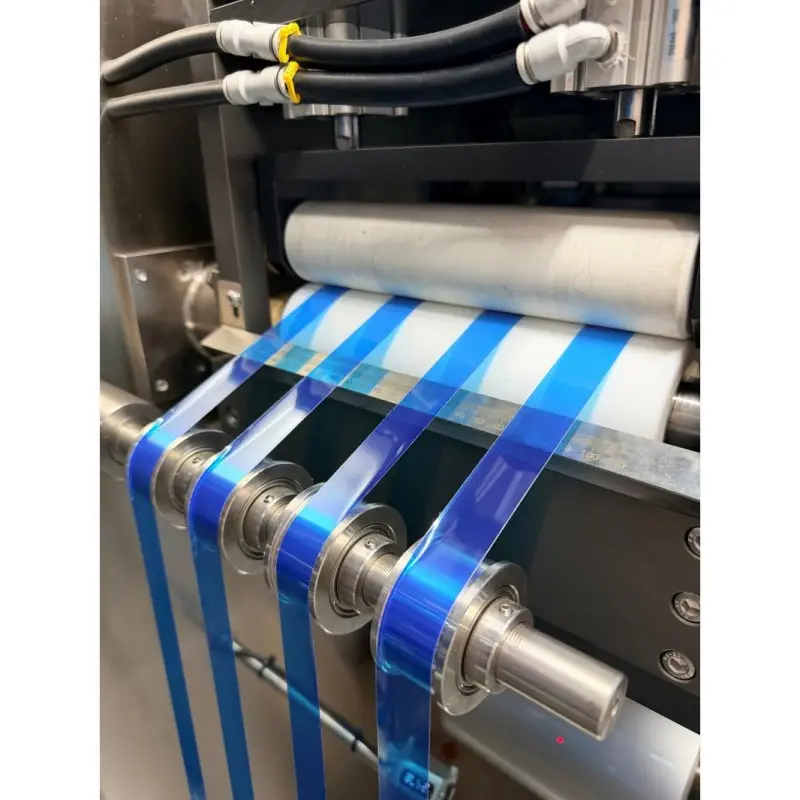
Water soluble film equipment refers to machinery and supporting systems used to handle, form, fill, seal, and process water-soluble film during packaging operations. These systems allow manufacturers to turn flexible film into measured, sealed portions for products that are designed to dissolve when exposed to water.
A modern Water Soluble Film Equipment setup can combine several stages into one coordinated process. POLYVA develops packaging solutions that can support film feeding, pouch formation, product dosing, sealing, and cutting, depending on the requirements of the application.
Understanding Water Soluble Film
Water-soluble film is a specialized packaging material designed to dissolve or disperse when exposed to water under suitable conditions. It is commonly used to create pre-measured portions of products that would otherwise require direct handling.
The film can be produced in different specifications to accommodate different products and packaging requirements. Its thickness, strength, dissolution characteristics, and handling properties can influence the equipment configuration.
What Does Water Soluble Film Equipment Include?
Water-soluble film equipment is not necessarily limited to a single machine. A packaging setup can contain multiple integrated components that perform different functions.
Typical equipment may include:
- Film feeding and unwinding systems
- Film forming components
- Automatic filling systems
- Sealing mechanisms
- Cutting or pouch separation systems
- Sensors and control systems
- Product feeding equipment
The exact configuration depends on the product, pouch design, production volume, and film specification.
How the Packaging Process Works
The basic packaging process begins when the film is supplied to the machine. Controlled film movement allows it to reach the forming section in the correct position.
The film is then shaped into a pouch or pocket. Once the pocket is prepared, the filling system introduces a predetermined amount of product before the film is sealed.
After sealing, individual packages can be separated and discharged for inspection or further handling.
Film Feeding and Positioning
Accurate film feeding is essential because every following stage depends on correct film positioning. Uneven movement can cause wrinkles, dimensional variation, or problems during sealing.
Film tension, guide alignment, roller condition, and machine speed can all influence feeding performance. Maintaining stable film movement helps create a more repeatable packaging process.
Pouch Forming
The forming stage creates the space needed to hold the product. Forming components are designed around the required pouch dimensions and film characteristics.
Consistent forming helps ensure that each package has similar dimensions and sufficient space for the intended product dose. Machine parameters may need to be adjusted when changing pouch sizes or film specifications.
Product Filling
Once a pouch has been formed, the filling system delivers the required quantity of product. The filling method depends largely on the physical properties of the material.
For example, liquids, powders, and granules may require different dosing mechanisms. Accurate filling helps maintain consistent package weights and reduces product waste.
Sealing the Film
After filling, the film must be sealed to create a closed package. The sealing process needs to be compatible with the specific water-soluble film.
Important factors can include sealing temperature, pressure, contact time, film alignment, and production speed. Properly controlled sealing helps protect the contents and maintain pouch integrity.
Cutting and Pouch Separation
Following sealing, the continuous film structure may be divided into individual packages. Cutting needs to be synchronized with pouch dimensions and machine timing.
Accurate separation helps prevent damaged edges and ensures that each finished pouch has a consistent size and shape.
Where Is Water Soluble Film Equipment Used?
Water-soluble packaging equipment can be used in various industries where pre-measured and easy-to-handle portions are beneficial.
Common applications include:
- Cleaning products
- Laundry formulations
- Dishwashing products
- Agricultural chemicals
- Industrial treatment products
- Specialized chemical formulations
The equipment configuration varies according to the product and its packaging requirements.
Benefits of Automated Equipment
Automation can make water-soluble film packaging more consistent and efficient. Instead of relying on repetitive manual processes, the machine can coordinate multiple operations within a controlled production cycle.
Potential benefits include:
- More consistent pouch dimensions
- Controlled product dosing
- Reduced manual handling
- Improved production repeatability
- Lower risk of certain packaging errors
- Easier monitoring of production parameters
Importance of Film Compatibility
Equipment must be compatible with the selected water-soluble film. Different films can vary in thickness, strength, flexibility, and sealing behavior.
Before starting full-scale production, manufacturers should evaluate how the film performs during feeding, forming, filling, sealing, and cutting. This helps identify suitable operating parameters.
Environmental Considerations
Water-soluble film can be sensitive to moisture. Exposure to unsuitable humidity conditions may affect its handling characteristics and packaging performance.
Proper film storage and controlled production conditions can help maintain more stable material behavior. Manufacturers should follow the storage and handling requirements associated with their specific film.
Maintenance Requirements
Regular maintenance helps keep water-soluble film equipment operating consistently. Film-contact components, forming parts, filling systems, sealing surfaces, and sensors should be inspected according to the equipment’s maintenance schedule.
Cleaning is also important, particularly around areas where product residue could interfere with filling or sealing.
Selecting the Right Equipment
Choosing equipment should begin with the packaging requirements rather than machine speed alone. Manufacturers should consider:
- Type of product
- Required pouch size
- Dose or fill quantity
- Film specification
- Production volume
- Sealing requirements
- Automation level
- Maintenance needs
Testing the actual film and product combination can provide valuable information before equipment is deployed for continuous production.
Conclusion
Water soluble film equipment provides the machinery needed to transform water-soluble film into practical, measured packages. By coordinating film feeding, pouch forming, filling, sealing, and cutting, automated systems can support consistent and efficient packaging operations.
The right equipment configuration depends on the film, product, pouch design, and production requirements. Careful material selection, proper machine settings, environmental control, and routine maintenance all contribute to reliable packaging performance.