

Industrial facilities in sectors such as automotive painting, printing, chemical processing, and plastic manufacturing often generate exhaust streams containing volatile organic compounds (VOCs). These emissions can contribute to air pollution, unpleasant odors, and workplace air quality concerns. For applications involving large exhaust volumes and relatively low VOC concentrations, zeolite rotor concentration technology can provide an effective approach to preparing contaminated air for further treatment.
Selecting a reliable Zeolite Rotor Concentrator Manufacturer is an important step toward achieving consistent industrial emission control. A qualified manufacturer should understand adsorption technology, exhaust characteristics, airflow requirements, pretreatment, and downstream oxidation. Evaluating these capabilities helps businesses select a system that fits their production environment, operational targets, and long-term maintenance needs.
Understanding Zeolite Rotor Concentrator Technology
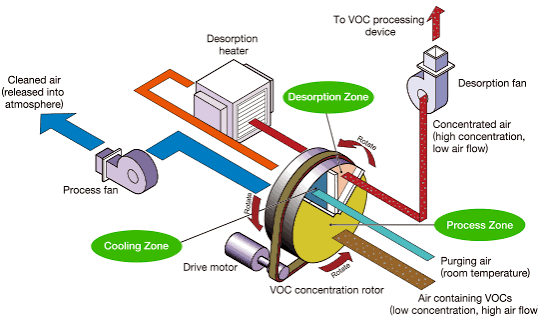
A zeolite rotor concentrator is an air pollution control system that captures compatible VOCs from a large volume of exhaust and transfers them into a smaller, more concentrated airflow.
The equipment contains a rotating structure made with zeolite-based adsorption material. As contaminated air passes through the adsorption section, selected VOC molecules are retained by the material. The rotor then moves through a desorption section, where heated air releases the captured compounds into a smaller air stream.
This concentrated stream is generally directed to a downstream treatment unit, such as a regenerative thermal oxidizer (RTO) or catalytic oxidizer, depending on the exhaust composition and process requirements.
A typical system includes:
- Adsorption section: Captures compatible VOC compounds from the incoming exhaust.
- Desorption section: Uses heated air to release the captured pollutants.
- Cooling section: Prepares the rotor for the next adsorption cycle.
- Rotor drive mechanism: Maintains continuous movement between operating zones.
- Fans and ductwork: Control the movement of process and regeneration air.
- Control system: Monitors operating conditions such as temperature, pressure, and rotor movement.
The overall performance depends on VOC composition, airflow, humidity, temperature, rotor material, and the configuration of the complete treatment system.
Why Manufacturer Selection Is Important
Zeolite rotor concentrators must be designed according to the characteristics of the actual exhaust stream. Different VOC compounds have different adsorption properties, and a rotor material suitable for one application may not be appropriate for another.
Poor equipment selection can result in insufficient adsorption, uneven airflow, excessive pressure drop, or reduced rotor service life. Inadequate integration with downstream treatment equipment can also affect overall emission control.
An experienced manufacturer can help businesses:
- Assess the exhaust stream before equipment selection.
- Choose a suitable zeolite rotor material.
- Calculate airflow and treatment capacity.
- Identify necessary pretreatment equipment.
- Integrate the concentrator with oxidation systems.
- Evaluate energy consumption and maintenance requirements.
These capabilities help ensure that the proposed equipment is based on actual process conditions rather than generic performance assumptions.
Key Qualities of a Reliable Zeolite Rotor Concentrator Manufacturer
1. Experience in Industrial VOC Treatment
Industrial exhaust characteristics vary across manufacturing sectors. Automotive painting facilities may produce solvent-containing emissions, while printing, coating, and plastic processing operations can generate different VOC mixtures.
A manufacturer with relevant project experience is better positioned to understand these differences and recommend suitable system configurations.
Before selecting a supplier, review its experience with:
- Industrial VOC adsorption and concentration.
- Zeolite rotor equipment design.
- RTO and catalytic oxidation systems.
- High-volume, low-concentration exhaust applications.
- Industrial filtration and pretreatment solutions.
Ask for relevant project references, technical documentation, and examples of applications with similar operating conditions.
2. Knowledge of Zeolite Rotor Materials
The zeolite rotor is the central component of the concentration process. Its performance depends on material formulation, pore structure, adsorption characteristics, and compatibility with the target VOC compounds.
A reliable manufacturer should explain how it selects rotor materials for a particular application.
Important considerations include:
- Adsorption characteristics for the target pollutants.
- Compatibility with expected humidity and temperature.
- Resistance to relevant contaminants.
- Mechanical stability and rotor construction.
- Airflow resistance and pressure drop.
- Expected service life under specified conditions.
Not every zeolite formulation can effectively adsorb every VOC. Material selection should therefore be supported by exhaust analysis and application-specific technical evaluation.
3. Accurate Exhaust Analysis and Equipment Sizing
Correct system sizing is essential for reliable operation. A concentrator designed using incomplete or inaccurate process information may not achieve the required treatment performance.
The manufacturer should evaluate:
- Total exhaust airflow.
- VOC concentration and chemical composition.
- Inlet air temperature.
- Relative humidity.
- Dust, oil mist, and other contaminants.
- Production schedules and operating hours.
- Variations during startup and shutdown.
- Required outlet emission levels.
These details help determine rotor dimensions, adsorption capacity, regeneration airflow, and the requirements of downstream treatment equipment.
4. Effective Rotor Design and Airflow Distribution
Uniform airflow is important for making effective use of the adsorption material. Uneven distribution can cause some rotor sections to receive greater pollutant loading than others, potentially reducing overall performance.
A well-engineered system should consider rotor dimensions, rotation speed, internal airflow zones, sealing arrangements, and pressure conditions.
The manufacturer should also explain how the equipment minimizes leakage between adsorption and desorption sections. Effective sealing helps prevent untreated air from bypassing the intended treatment path and supports stable operation.
5. Reliable Desorption and Temperature Control
Desorption releases captured VOCs from the zeolite material so that the rotor can continue its adsorption cycle. This process typically uses heated air, with the operating temperature selected according to the rotor material and the properties of the pollutants.
A suitable system should provide:
- Stable desorption temperature.
- Appropriate regeneration airflow.
- Consistent heat distribution.
- Temperature monitoring and protective controls.
- Coordination between rotor speed and regeneration conditions.
Excessive or insufficient heating can affect regeneration performance and equipment durability. Operating conditions should follow the manufacturer’s technical specifications.
6. Appropriate Pretreatment Capabilities
Industrial exhaust may contain dust, oil mist, sticky aerosols, and other substances that can interfere with rotor performance. These contaminants may accumulate on the adsorption material, restrict airflow, or affect its adsorption capacity.
Depending on the application, pretreatment may involve:
- Particulate filtration.
- Oil mist removal.
- Cooling or temperature adjustment.
- Moisture management.
- Additional gas cleaning processes.
A reliable manufacturer should identify potential contamination risks during the design stage and recommend pretreatment based on the actual exhaust composition.
7. Integration With Downstream Oxidation Equipment
A zeolite rotor concentrator captures and concentrates compatible VOCs, but it does not necessarily destroy them. The concentrated exhaust generally requires a separate treatment process.
Two common downstream options are:
Regenerative Thermal Oxidizer (RTO): An RTO uses controlled high-temperature oxidation to destroy many combustible organic compounds. Heat recovery helps reduce the energy required for continuous operation.
Catalytic Oxidizer: A catalytic system uses a catalyst to promote oxidation, often at lower operating temperatures than conventional thermal oxidation. Its suitability depends on VOC composition and the presence of substances that could interfere with catalyst performance.
The manufacturer should evaluate the concentrator and downstream oxidation unit as an integrated system. Airflow, VOC loading, temperature, and chemical compatibility must be considered together.
How to Evaluate Manufacturing Quality
Equipment construction affects durability, operating stability, and maintenance requirements. Buyers should review the manufacturer’s production standards and the design of key components.
Housing and Structural Materials
The equipment housing should be suitable for the expected temperature, humidity, and chemical environment. Structural components must provide adequate support for the rotor, drive mechanism, and internal assemblies.
Sealing Arrangements
Seals between different airflow zones help reduce unwanted air mixing. Ask how sealing components are selected, installed, inspected, and replaced.
Rotor Drive System
The motor, gearbox, bearings, and related components should be selected according to the expected operating conditions. Consistent rotor movement is important for maintaining the intended adsorption and regeneration cycle.
Control and Monitoring Equipment
Temperature sensors, pressure monitoring devices, airflow controls, and motor protection systems help operators monitor equipment conditions and identify abnormal operation.
Maintenance Access
Inspection panels and accessible service points make it easier to examine the rotor, seals, filters, and drive components. Practical maintenance access can reduce service time and help limit production interruptions.
Energy Efficiency and Operating Costs
Energy consumption is an important consideration when comparing zeolite rotor concentrators. Concentrating VOCs can reduce the volume of exhaust requiring high-temperature treatment, but the complete system still consumes energy through fans, rotor movement, heating, and downstream oxidation.
A manufacturer should provide estimates based on the facility’s actual operating conditions.
Factors influencing energy consumption include:
- Exhaust airflow and VOC concentration.
- Desorption air volume and temperature.
- Rotor pressure drop.
- Fan efficiency and ductwork resistance.
- Downstream oxidation requirements.
- Heat recovery arrangements.
- Production schedules and operating hours.
Buyers should evaluate total operating costs rather than relying exclusively on advertised concentration ratios or general efficiency claims. A realistic assessment should include electricity, heating energy, routine maintenance, and replacement components.
Maintenance and After-Sales Technical Support
Regular maintenance helps preserve system performance and identify developing problems before they cause major interruptions.
A dependable manufacturer should provide operating manuals, inspection schedules, troubleshooting guidance, and access to technical assistance.
Typical maintenance activities include:
- Inspecting the rotor for dust accumulation and contamination.
- Checking seals for wear and leakage.
- Monitoring rotor movement and drive components.
- Verifying desorption temperature and airflow.
- Inspecting pretreatment filters and associated equipment.
- Monitoring pressure drop across the rotor.
- Reviewing system alarms and VOC treatment performance.
- Arranging professional inspection when operating conditions change.
The supplier should also clarify replacement component availability, warranty coverage, service arrangements, and technical support procedures.
Questions to Ask Before Choosing a Manufacturer
A structured evaluation can help buyers compare suppliers and identify whether their proposed equipment meets the facility’s requirements.
Consider asking:
- Which VOC compounds is the proposed rotor designed to handle?
- What airflow and inlet concentration ranges can the system accommodate?
- How is the zeolite material selected?
- What pretreatment is required?
- How are adsorption, desorption, and cooling zones configured?
- How is rotor speed controlled?
- What are the estimated energy requirements?
- How will the system integrate with an RTO or catalytic oxidizer?
- What maintenance activities are required?
- What technical support and replacement parts are available?
A reliable supplier should provide clear explanations supported by process information, engineering calculations, and realistic operating assumptions.
Common Mistakes to Avoid When Selecting a Supplier
Businesses should avoid decisions based solely on equipment price or broad performance claims.
Common mistakes include:
- Ignoring exhaust analysis: Incomplete information can lead to unsuitable rotor materials or incorrect system sizing.
- Focusing only on concentration ratio: A high concentration ratio does not automatically guarantee the required emission reduction.
- Overlooking pretreatment: Dust, oil mist, and incompatible substances can affect rotor performance.
- Ignoring downstream treatment: Concentrated VOCs generally require an appropriate final treatment process.
- Comparing only purchase prices: Energy use, maintenance, and replacement costs affect total ownership expenses.
- Neglecting after-sales service: Limited technical support can make troubleshooting and maintenance more difficult.
Evaluating technical suitability, construction quality, operating costs, and service capabilities provides a more complete basis for supplier selection.
Conclusion
A reliable zeolite rotor concentrator manufacturer should combine industrial VOC treatment experience with knowledge of adsorption materials, accurate system sizing, effective airflow design, and dependable technical support. The manufacturer should understand how adsorption, desorption, pretreatment, and downstream oxidation work together to provide an integrated solution.
Before purchasing, businesses should assess exhaust composition, airflow, humidity, temperature, energy requirements, equipment construction, and maintenance arrangements. Selecting a supplier based on these factors can help industrial facilities improve VOC treatment consistency, support reliable operation, and manage long-term operating costs.