

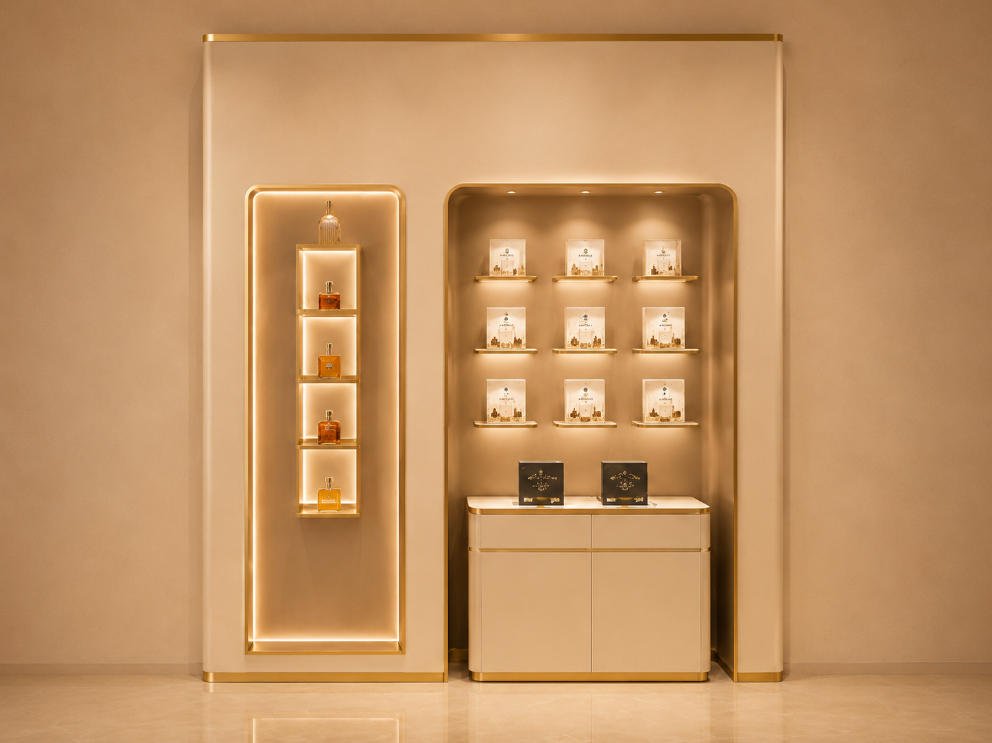
A fragrance showcase needs to withstand everyday retail activity while maintaining a clean and attractive appearance. Customers may inspect products closely, staff may restock shelves throughout the day, and glass surfaces may require frequent cleaning. For this reason, material selection should be considered an important part of the overall display design.
Effective Perfume Showcase Design involves more than choosing materials based on appearance. Glass, metal, wood-based panels, acrylic, hardware, and surface finishes all have different characteristics that can affect durability, maintenance, product visibility, and the overall structure of the display.
Begin With the Display’s Requirements
Before selecting materials, identify how the showcase will be used. A wall-mounted display may have different structural requirements from a large freestanding unit, while a high-traffic fragrance counter may need surfaces that tolerate frequent contact.
Consider factors such as:
- Expected customer traffic
- Number and weight of products
- Display dimensions
- Frequency of cleaning
- Lighting integration
- Security requirements
- Available installation space
- Expected service life
These factors provide a practical starting point for material selection.
Use Glass for Product Visibility
Glass is commonly associated with fragrance displays because it provides a clear view of bottles while maintaining separation between customers and merchandise.
When selecting glass, retailers should consider thickness, safety characteristics, clarity, and how it will be supported by the surrounding structure. Large panels also need suitable framing and hardware to remain stable during everyday use.
Consider Tempered or Safety Glass
Where appropriate, safety-oriented glass options can provide additional protection for retail environments. Tempered glass, for example, is designed to provide greater resistance to certain forms of impact than ordinary glass.
The appropriate specification depends on the size, installation method, and intended application of the showcase.
Select Structural Materials Carefully
The frame provides much of the showcase’s structural support. Metal profiles can offer a clean contemporary appearance, while wood-based materials can introduce warmth and visual contrast.
The choice should account for load requirements, construction methods, finish quality, and compatibility with glass panels and shelving.
Evaluate Metal Components
Metal may be used for frames, brackets, supports, hinges, handles, and other structural elements. Different finishes can also affect the visual character of the display.
Durability is particularly important for components that are frequently handled, such as door hardware and handles.
Use Wood-Based Panels Where Appropriate
Wood-based panels can provide a range of finishes and can be incorporated into back panels, cabinets, bases, or decorative sections.
They can also help conceal storage areas and electrical components. The selected finish should be suitable for the expected cleaning routine and retail environment.
Consider Acrylic for Specific Applications
Acrylic can be useful for lightweight shelves, dividers, risers, signage holders, and other display details. Its lighter weight can make it practical for certain applications.
However, retailers should consider its resistance to scratching and cleaning requirements when deciding where it should be used.
Think About Surface Finishes
The finish applied to a material can influence both appearance and maintenance. Glossy surfaces may create a polished look but can make fingerprints more visible, while certain matte finishes may be easier to maintain visually.
The finish should also work with the lighting system because highly reflective surfaces can contribute to unwanted glare.
Match Materials With Lighting
Material selection and lighting should be planned together. Glass can reflect nearby fixtures, metallic surfaces can produce bright highlights, and dark finishes may absorb more light.
Testing the proposed materials under the intended lighting can reveal reflections or visibility issues before the showcase is manufactured.
Pay Attention to Shelving Materials
Shelves need to support products securely while maintaining an attractive appearance. Glass shelves can create a visually light effect, while solid shelves can provide stronger visual separation between collections.
The shelf material should be selected according to product weight, span, dimensions, and the overall construction of the showcase.
Consider Hardware Durability
Small components can have a major effect on long-term usability. Hinges, locks, brackets, drawer runners, handles, and shelf supports may be used repeatedly throughout the life of the display.
Selecting suitable hardware can help maintain smooth operation and reduce unnecessary maintenance.
Plan for Cleaning
Perfume displays often feature transparent surfaces that make dust and fingerprints easy to notice. Materials should therefore be compatible with the store’s regular cleaning procedures.
Avoid selecting finishes that require unusually complicated maintenance unless there is a clear design reason for doing so.
Think About Chemical and Surface Resistance
Cleaning products, cosmetics, and other substances may occasionally come into contact with display surfaces. Material finishes should be evaluated for their ability to withstand the products and cleaning methods commonly used in the store.
Staff should also follow the manufacturer’s recommendations for cleaning different surfaces.
Choose Materials That Support Security
Material selection can contribute to merchandise protection. Strong framing, secure glass panels, reliable locks, and sturdy shelving can work together to create a more controlled display environment.
Security components should be incorporated into the construction rather than treated as an afterthought.
Balance Weight and Stability
A showcase made from heavy materials may require additional structural support and more complicated installation. Lightweight materials can simplify some applications but may not provide the required strength for every component.
The final construction should balance weight, stability, durability, and installation requirements.
Consider High-Traffic Areas
Displays located near entrances, checkout areas, or busy walkways may experience more frequent contact than units positioned in quieter sections of a store.
For these locations, durable surfaces and robust hardware may be especially important.
Coordinate Materials Across the Store
A fragrance display should generally fit the visual character of its surroundings. Matching or complementary materials can connect the showcase with counters, shelving, flooring, wall panels, and other fixtures.
This does not mean every surface must be identical. Carefully chosen contrasts can also create a distinctive display while maintaining visual consistency.
Allow for Future Changes
Material selection should take future modifications into account. Retailers may eventually change shelf positions, lighting, product categories, or display configurations.
Modular construction and replaceable components can make future adjustments easier and may extend the practical usefulness of the showcase.
Consider Installation and Transportation
Large glass panels, heavy frames, and assembled cabinets can create logistical challenges. Material choices should therefore be considered alongside transportation routes, installation access, and the final location of the showcase.
Planning these details early can reduce complications during installation.
Review the Manufacturer’s Capabilities
Different manufacturers may specialize in different combinations of materials and construction methods. Retailers should ask about available material specifications, finishes, hardware, customization, assembly, and maintenance requirements.
DG Display Showcase can be considered when retailers are evaluating customized fragrance displays that require coordination between glass, structural materials, lighting, shelving, and other components.
A Practical Material Selection Checklist
Before approving the materials for a fragrance showcase, consider:
- Is the glass appropriate for the intended application?
- Can the frame support the required load?
- Are shelves suitable for the size and weight of the products?
- Can surfaces withstand regular cleaning?
- Are finishes resistant to expected wear?
- Will materials create unwanted lighting reflections?
- Are hinges, locks, and other hardware durable?
- Is the overall structure stable?
- Can damaged or worn components be replaced?
- Does the material combination complement the store interior?
- Can the design accommodate future modifications?
Final Thoughts
Durable perfume showcase design depends on selecting materials according to both visual and practical requirements. Glass can provide product visibility, structural materials can create stability, and carefully selected finishes and hardware can support long-term everyday use.
Rather than choosing materials based solely on appearance, retailers should consider product weight, customer traffic, maintenance, lighting, security, installation, and future changes. A balanced material strategy can help create a fragrance showcase that remains functional and presentable throughout its service life.